
Yes—you can train to become a Pilates instructor while pregnant, but enrollment, physical participation, and completing practical assessments are separate decisions. Teachpilates offers $497 tuition and flexible self-paced online study in 2026; before enrolling, check the assessment requirements with the provider and discuss the physical parts of training with your pregnancy care professional.
- To become Pilates instructor while pregnant, separate coursework from physical practice and confirm assessment arrangements before enrolling.
- Teachpilates offers self-paced Pilates instructor certification for $497; flexibility does not establish pregnancy-specific assessment accommodations.
- Choose training around your intended teaching scope, not a deadline tied to your due date.
- General Pilates certification does not establish specialist prenatal teaching competence or dedicated hands-on apparatus qualification.
Can you become a Pilates instructor while pregnant?
Yes, provided the course requirements and your individual pregnancy circumstances fit together. You can approach academic study, observation, physical practice, and teaching assessments as distinct activities rather than treating teacher training as one continuous workout.
The Teachpilates Pilates instructor certification course covers anatomy, mat instruction, introductory Reformer concepts, cueing, and business skills. Self-paced study lets you organize academic work around your schedule, but it does not, by itself, confirm permission to replace demonstrations or postpone assessments.
Before paying, work through these steps:
- Define your teaching goal. Decide whether you want mat-teaching foundations or a pathway toward dedicated apparatus instruction.
- Request the assessment requirements. Ask what you must demonstrate, record, attend, or teach.
- Discuss physical participation. Show your pregnancy care professional the actual activities, not just the course title.
- Confirm arrangements in writing. Establish what happens if you need to pause, modify participation, or finish practical work later.
Your answer depends on those requirements—not on whether another pregnant student completed a different program.
Why this matters
Pregnancy raises two different questions: whether you can learn to teach Pilates and whether a particular physical activity is appropriate for you now. A course provider answers questions about enrollment and assessments. Your pregnancy care professional advises on your individual health circumstances.
Keep those roles separate. A provider's willingness to enroll you is not medical clearance, and medical clearance does not waive a course's practical requirements.
This distinction also protects your enrollment decision. You need a course that fits your intended teaching scope and a completion plan that does not depend on ignoring symptoms or rushing recovery after birth.
Which training format fits your pregnancy plans?
Choose the format that gives you a workable route through both study and assessment. Online learning, scheduled practical training, and postponing physical components solve different problems.
These are format-level comparisons, not promises about any provider's policies. Confirm the details for the course you are considering.
| Format | Best for | Main advantage | Main limitation |
|---|---|---|---|
| Teachpilates self-paced online certification | Aspiring instructors who need flexible academic study | You can organize coursework around your schedule | Self-paced delivery does not confirm assessment accommodations, prenatal specialization, or hands-on apparatus qualification |
| Scheduled in-person training | Learners prioritizing direct practical feedback | A tutor can observe teaching and movement in person | Fixed attendance and physical participation requirements need checking |
| Theory now, practical training later | Learners who want to study without committing to immediate physical completion | Separates academic progress from practical timing | Only works when the provider permits the arrangement and explains completion deadlines |
Teachpilates is best suited to aspiring Pilates instructors who need self-paced online study rather than a fixed classroom schedule. Its flexibility addresses study timing; you still need to confirm whether the assessment format fits your pregnancy plans.
Do not assume in-person training is automatically unsuitable, either. Ask about attendance, observation, demonstrations, and permitted modifications before ruling a format in or out.
What can you study without treating every lesson as a workout?
Teacher training involves more than performing exercises. Reading anatomy material, reviewing exercise explanations, developing verbal cues, and studying business topics are different tasks from demonstrating a movement sequence.
That distinction gives you a practical way to plan. Organize your learning into these categories:
- Academic study: Anatomy, terminology, lesson review, and business concepts.
- Teaching preparation: Written class plans, cue development, and observation notes where the course permits them.
- Physical practice: Your own movement practice and any required demonstrations.
- Assessment work: Whatever the provider requires you to submit or complete for certification.
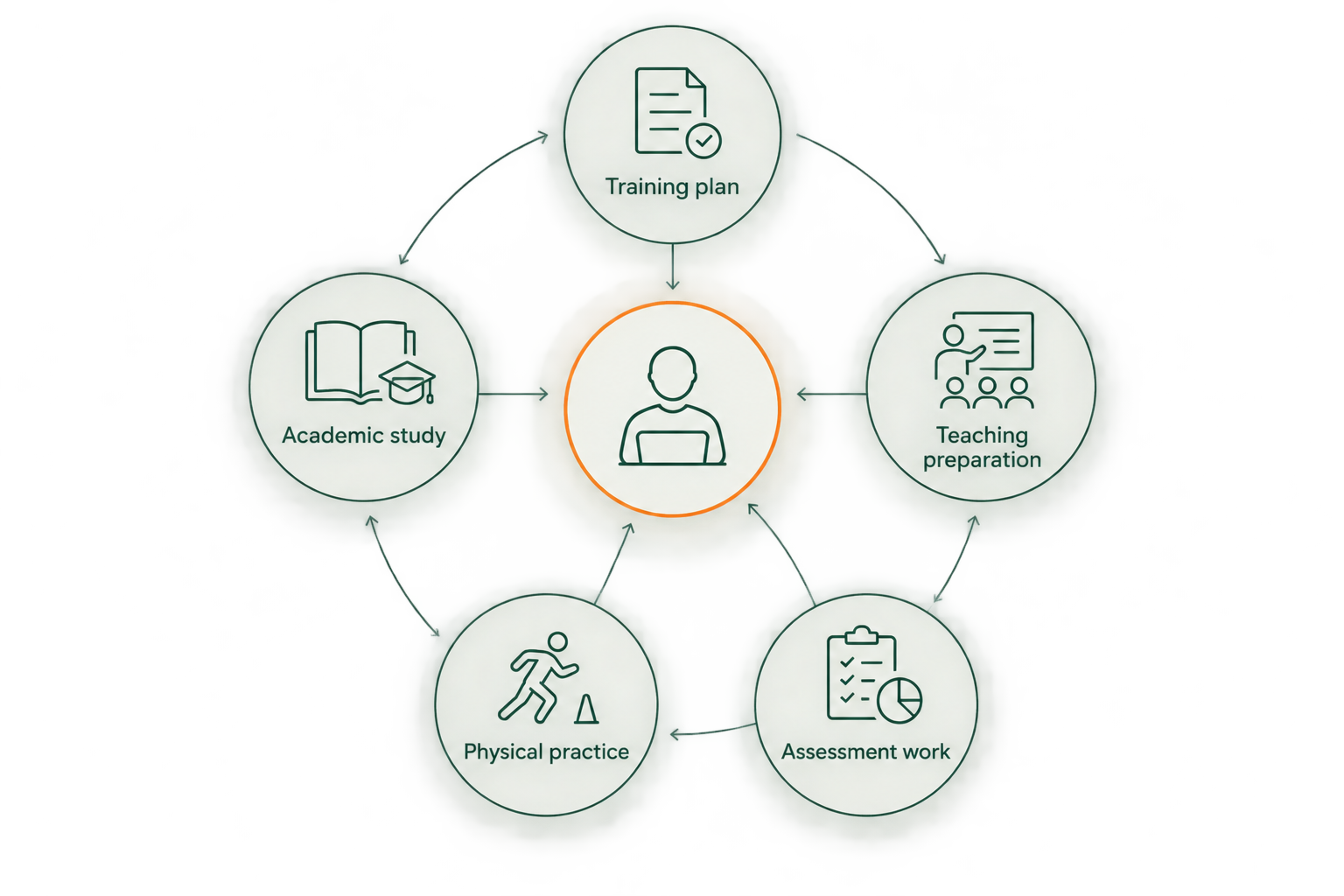
These categories help you ask better questions; they do not establish that a provider allows substitutions. Watching a demonstration is not automatically an accepted replacement for performing or teaching it.
Before enrolling in 2026, request the assessment instructions. Look for the exact distinction between understanding an exercise, demonstrating it yourself, and coaching another person through it.
What should you ask about assessments and course access?
Ask about the completion rules before you ask how quickly you can finish. A flexible study format is useful only when you understand the deadlines and practical requirements attached to it.
Send the provider a short, specific request:
- What written and practical assessments must I complete?
- Must I personally demonstrate every assessed exercise?
- Can an assessment evaluate my teaching while another person demonstrates?
- What arrangements are available if pregnancy prevents a required activity?
- Does course access expire, and what happens if I need a longer pause?
- Are extensions, reassessments, or postponed practical sessions subject to additional charges?
Ask for written answers that apply to your chosen course. A general statement that training is flexible does not answer whether an assessment can move or whether access continues during a break.
Also distinguish support from assessment policy. A helpful tutor does not necessarily have authority to change certification requirements, so confirm who approves any agreed arrangement.
Why your training plan varies during pregnancy
There is no single pregnancy timetable that determines when every aspiring instructor should enroll or finish. Build your plan around the requirements you can verify and the individual health advice you receive.
The main factors are:
- Your clinical circumstances. Your pregnancy care professional needs to advise on physical participation and any restrictions relevant to you.
- Your existing Pilates experience. Being familiar with a movement does not establish that it is appropriate throughout your pregnancy.
- The assessment format. Written work, recorded demonstrations, and observed teaching place different demands on you.
- Course access rules. Expiry dates and extension terms determine how much room you have to pause.
- Your intended teaching scope. Mat foundations and dedicated apparatus training require different planning.
- Your recovery and care responsibilities. Do not make completion depend on a fixed return-to-practice date after birth.
Set a study plan you can revise, not a physical deadline you feel pressured to meet. Academic progress still counts as preparation even when practical work needs a different schedule.
What does the $497 tuition tell you—and what should you check?
Teachpilates lists $497 tuition for its self-paced Pilates instructor certification. That gives you a stated tuition figure for your 2026 enrollment comparison, not proof that every future professional expense is included.
Before paying, ask whether the stated tuition includes all required assessments, course materials, and certification processing. Confirm the terms for course access, reassessment, extensions, and refunds rather than assuming how those policies work.
Separate course costs from later teaching requirements. Depending on where and how you intend to teach, you need to investigate insurance, employer expectations, equipment access, and any additional training appropriate to your role.
Do not buy a broader teaching scope than the course actually establishes. Mat-teaching foundations and introductory Reformer concepts are not the same as dedicated hands-on apparatus qualification, and an independent credential should never be assumed to be included.
Can you complete practical assessments while pregnant?
You can complete practical assessments only when the required activities fit your clinical advice and the provider's assessment rules. Pregnancy does not establish an automatic exemption, and self-paced study does not establish an alternative assessment route.
Ask exactly what the assessor needs to see: your movement, your verbal instruction, your observation skills, or a combination. Do not attempt an exercise against clinical advice simply to meet a submission deadline.
If the requirements do not fit your circumstances, confirm whether you can defer that component before enrolling. A workable later assessment is a better plan than an assumed accommodation.
Does being pregnant qualify you to teach prenatal Pilates?
No—personal pregnancy experience does not establish prenatal teaching competence. Understanding your own experience is different from screening clients, recognizing when referral is needed, and adapting instruction within an appropriate professional scope.
General instructor certification should not be presented as specialist prenatal training unless that scope is explicitly established. If pregnant clients are your intended audience, investigate suitable prenatal education, insurance requirements, and the expectations of the setting where you want to teach.
The same boundary applies to clinical claims. Pilates instruction is not a substitute for individualized maternity care, diagnosis, or rehabilitation advice.
Should you enroll now or wait until after birth?
Enroll now when the study format fits your life and the practical completion rules are clear. Waiting is the better choice when required physical activities conflict with clinical advice or when the provider cannot give you a workable completion arrangement.
For a 2026 enrollment decision, use a simple test: can you explain what you will study now, what you must physically complete, and what happens if your plans change? If any answer depends on an assumption, resolve it before paying.
There is no need to treat birth as a guaranteed restart date. Discuss your return to physical activity with your care professional and confirm course deadlines independently.
Review the course before enrolling
Explore the self-paced curriculum, then confirm assessment and access requirements for your circumstances.
FAQ
Can I start Pilates teacher training during my first pregnancy?
Yes, you can investigate and begin suitable teacher training during your first pregnancy. Confirm the provider's enrollment and assessment requirements, and discuss physical participation with your pregnancy care professional.
Is online Pilates certification better than in-person training while pregnant?
Online study is better for schedule flexibility; in-person training offers direct practical observation. The better fit depends on the actual attendance, physical practice, and assessment requirements—not the delivery label alone.
Does Teachpilates offer self-paced Pilates instructor training?
Teachpilates offers self-paced online Pilates instructor certification covering anatomy, mat instruction, introductory Reformer concepts, cueing, and business skills. Confirm pregnancy-related assessment arrangements and course access terms before enrolling.
Do I have to demonstrate every Pilates exercise to get certified?
You must check your chosen course's assessment requirements to know what you personally need to demonstrate. Do not assume that verbal cueing or watching another person perform an exercise is an accepted substitute.
Can I pause my Pilates course after giving birth?
A pause depends on your provider's access, deadline, and extension policies. Get those terms in writing before enrolling, including any conditions or additional charges attached to extending your completion period.
Will a general Pilates certificate let me teach pregnant clients?
A general Pilates certificate does not by itself establish specialist prenatal teaching competence. Check the training scope, insurance requirements, and any additional education needed for the clients you intend to teach.
What should I check before enrolling in Pilates training in 2026?
Before enrolling in 2026, check teaching scope, prerequisites, assessment tasks, access limits, and total required charges. Then confirm that the physical requirements fit your clinical advice and that your intended employer accepts the training.
One last thing
Ask the provider to describe what you must teach, not just what you must perform. That question exposes the difference between a course built around exercise participation and an assessment of your ability to instruct another person.
For your 2026 plan, keep a written record of the agreed requirements and any approved arrangements. You should finish enrollment knowing what completion involves—not hoping flexibility will be defined later.