
Best self-paced option for aspiring online mat instructors: Teachpilates, with $497 tuition and flexible study. For the best Pilates certification match in 2026, choose live online training when you need scheduled feedback, or hands-on apparatus training when your goal is Reformer teaching—not just online course completion.
- Teachpilates is the best Pilates certification fit here for beginners seeking self-paced study and mat-teaching foundations.
- Choose live online Pilates teacher training when scheduled instruction and observed practice are your priorities.
- Choose hands-on apparatus training for Reformer teaching; introductory concepts do not replace equipment-specific practical preparation.
- Check assessments, course access, employer requirements, and insurance before enrolling.
This guide is published by Teachpilates, which offers the course discussed below. It compares training formats rather than claiming an independently tested ranking of competing providers.
Why this matters
Learning Pilates online and learning to teach Pilates online are different decisions. Your course needs to explain movement, but your teaching preparation also needs to address what you can see, explain, and correct through a camera.
For your 2026 enrollment decision, start with the class you want to lead. Online mat teaching, studio mat classes, and equipment-based sessions require different preparation; a certificate title alone does not establish that scope.
Teachpilates is best for first-time instructors seeking self-paced Pilates certification focused on teaching foundations. Its curriculum covers anatomy, mat instruction, introductory Reformer concepts, cueing, and business skills; dedicated hands-on apparatus qualification is a separate consideration.
What makes the best Pilates certification for online teaching?
Judge each course against these criteria before comparing its enrollment page:
- Teaching scope: Identify whether the course prepares you for mat instruction, introduces apparatus concepts, or includes dedicated apparatus training.
- Observed teaching: Ask whether an assessor watches you teach, how feedback works, and what you must demonstrate.
- Remote cueing: Look for opportunities to practice explaining movement without relying on touch or a nearby demonstration.
- Study format: Match self-paced lessons, scheduled classes, and practical attendance to your actual calendar.
- Access and assessment terms: Confirm course-access limits, submission deadlines, assessment requirements, and reassessment arrangements.
- Acceptance for your goal: Check the requirements of the employer, platform, venue, or insurer you intend to use.
Do not treat a long curriculum list as proof of practical readiness. Ask what you will be able to demonstrate, not just which topics you will read about.
Online Pilates certification options at a glance
The order below prioritizes a beginner planning to teach online mat sessions. It is not a ranking of named competing schools, and the alternatives describe formats to investigate rather than verified individual programs.
| Option | Best for | Standout feature | Key limitation |
|---|---|---|---|
| Teachpilates self-paced course | Beginners needing flexible foundational study | Anatomy, mat instruction, cueing, business skills, and introductory Reformer concepts | Introductory apparatus content is not dedicated hands-on apparatus qualification |
| Live online teacher training | Learners who need scheduled observation and feedback | Real-time interaction when included in the course | Fixed attendance; assessment and feedback arrangements need checking |
| Hybrid or in-person apparatus training | Aspiring Reformer instructors needing equipment-based preparation | Physical equipment practice when included in the program | Requires attendance and equipment access; online delivery skills still need practice |
1. Teachpilates: best Pilates certification for self-paced study
The Teachpilates Pilates certification course offers self-paced online study for $497. You study anatomy, mat instruction, cueing, business skills, and introductory Reformer concepts as you prepare to move from practitioner to teacher.
Best for: First-time instructors who need flexible study and want to build mat-teaching foundations before taking on broader teaching responsibilities.
The format fits a learner who can organize independent study without a fixed classroom schedule. It also gives you a clear distinction to maintain: learning introductory Reformer concepts does not establish hands-on competence with apparatus.
Teachpilates pros
- Self-paced study lets you organize learning around your existing commitments.
- Anatomy and cueing belong alongside exercise instruction in the stated curriculum.
- Business skills address part of the transition from personal practice to teaching.
- Mat instruction and introductory Reformer content let you distinguish foundational learning from later apparatus specialization.
Teachpilates cons
- Introductory Reformer concepts do not replace dedicated hands-on apparatus training.
- Self-paced learning puts scheduling and follow-through on you.
- Course completion alone does not establish acceptance by every studio, platform, or insurer.
Before enrolling, request the current assessment requirements and course-access terms. Confirm whether your teaching is observed, how questions receive answers, and what happens if you need another assessment attempt.
For online teaching specifically, add deliberate camera-based practice to your preparation. Record a short explanation, watch it back, and check whether someone could follow the instructions without seeing your demonstration continuously.
Verdict: Buy for flexible foundational study if the assessment and access terms match your needs; skip it as a substitute for dedicated apparatus qualification.
2. Live online training: best for scheduled teaching feedback
Live online teacher training brings instruction into scheduled video sessions. Choose a course that explicitly includes observed practice if your priority is feedback on how you explain, watch, and adapt a class.
Best for: Learners who progress better with appointments, instructor interaction, and external accountability.
The key distinction is participation versus assessment. Joining a live lesson does not necessarily mean an instructor will evaluate your own teaching, so ask for the assessment format before you commit.
Live online training pros
- Scheduled sessions create a defined study routine.
- Real-time discussion gives you a place to ask questions during instruction.
- Observed teaching, when included, lets an assessor respond to your actual cueing.
- Video-based practice gives you a setting for rehearsing remote communication.
Live online training cons
- Attendance requirements reduce scheduling flexibility.
- Live instruction does not automatically include individual teaching assessment.
- Screen-based learning does not replace physical apparatus practice.
Ask how much of each session involves watching an instructor and how much involves teaching yourself. Also establish whether recordings replace missed attendance or simply support revision; those are different arrangements.
Verdict: Buy when observed teaching and the attendance schedule are confirmed; hold when the provider cannot explain its feedback process.
3. Hands-on apparatus training: best for Reformer teaching goals
Hybrid or in-person apparatus training is the format to investigate when your goal includes teaching on a Reformer. Prioritize a program that specifies equipment practice, supervision, and apparatus-specific assessment.
Best for: Aspiring instructors whose intended work includes equipment-based teaching rather than online mat classes alone.
Reformer preparation involves more than recognizing exercises on video. Your training choice needs to address the physical equipment you intend to teach on and the practical decisions involved in using it.
Hands-on apparatus training pros
- Equipment-based practice connects instruction with physical setup.
- Supervised sessions, when included, provide feedback on apparatus handling.
- Apparatus-specific assessment gives you a concrete requirement to investigate.
- A clearly defined equipment scope helps you explain your preparation to prospective employers.
Hands-on apparatus training cons
- Practical attendance requires access to an appropriate training location.
- Equipment access adds another commitment to your study plan.
- Apparatus preparation does not automatically cover online class delivery.
For a 2026 Reformer teaching goal, ask exactly which apparatus is covered and where you will practice. Do not assume a general certificate includes every piece of studio equipment.
Verdict: Buy for an equipment-teaching goal when practical training and assessment are explicit; skip it as your first purchase if you only want online mat-teaching foundations.
Turn a course choice into a teaching plan
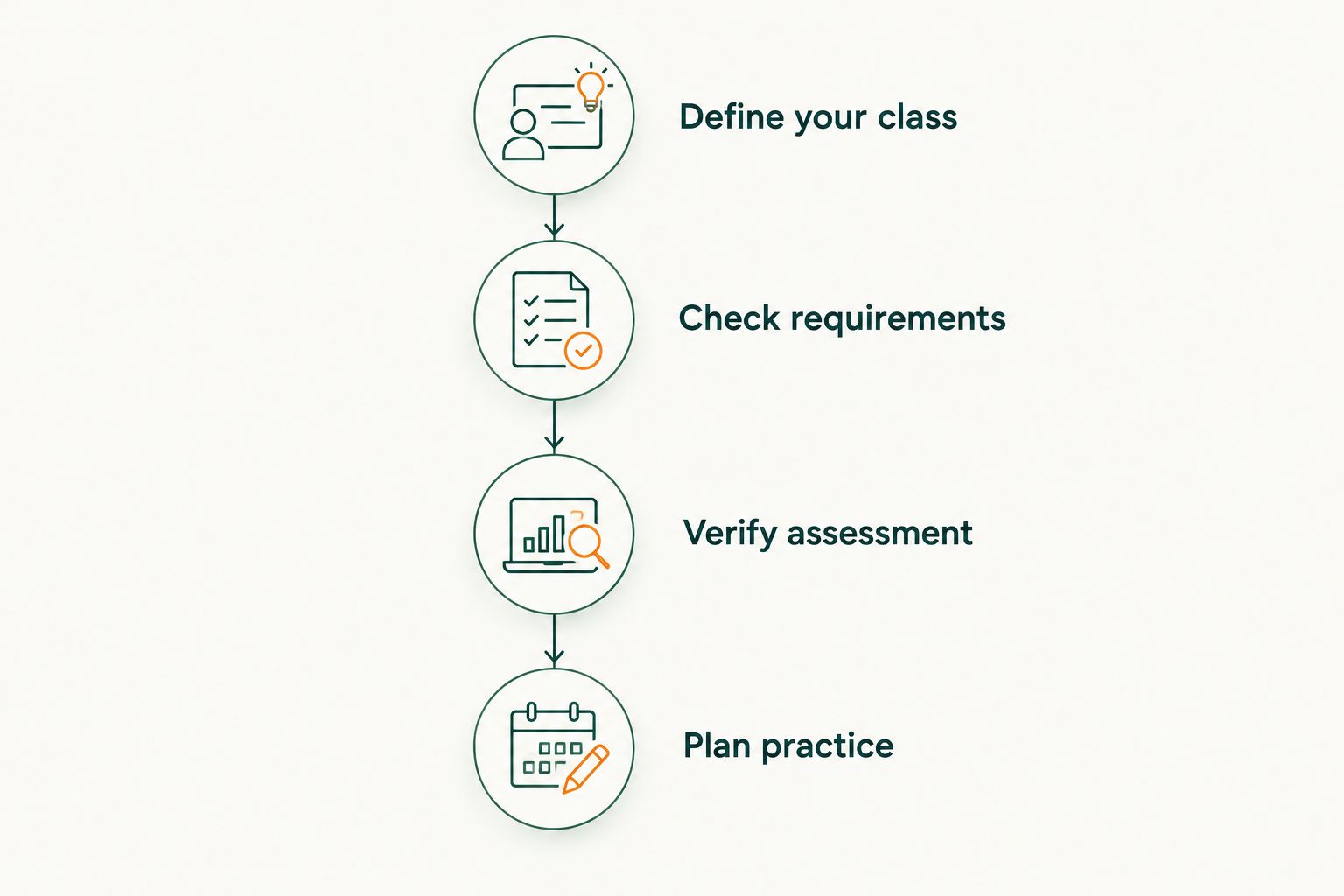
Use this sequence before enrolling. It separates choosing a certificate from preparing to lead the kind of class you actually want to offer.
Define your class
Write down your intended format: online mat, studio mat, or apparatus instruction. Add who you intend to teach and whether you plan to work independently or apply to an employer.
Keep your first goal narrow. A clearly defined beginner mat class is a more useful planning target than an undefined ambition to teach every format.
Check requirements
Ask the relevant employer, platform, venue, or insurer what it requires. Request specific answers about training scope, practical assessment, first aid, and any separate credentials.
Make these checks before paying tuition. A course provider's completion certificate and an independent credential are separate things unless the provider explicitly confirms otherwise.
Verify assessment
Ask what you must submit, what earns a pass, and whether anyone observes your teaching. Get the current requirements in writing rather than assuming a multiple-choice exam demonstrates practical instruction.
Use the guide to written vs practical assessments to organize those questions. Look for evidence of both understanding and application.
Plan practice
As a planning exercise, record a 10-minute mock class, then review it before recording again. This is a suggested rehearsal, not a certification requirement or a claim that a short recording establishes competence.
Schedule 2 practice sessions in your weekly calendar if that is realistic for you. Give one session to explaining movement and the other to watching a practice participant and responding to what you see.
What your online teaching rehearsal should reveal
A rehearsal is useful when it exposes a specific teaching problem. Do not judge it only by whether you completed the exercise sequence.
- Camera position: Can a participant see the movement you are demonstrating?
- Verbal instructions: Do your words explain the starting position and intended action?
- Observation: Can you watch the participant instead of demonstrating continuously?
- Transitions: Do you explain how to move between positions without rushing?
- Scope: Do you recognize when a question needs referral rather than an improvised answer?
Try a 20-minute rehearsal once a shorter segment feels organized. That suggested duration gives you room to examine transitions and pacing; it is not a published qualification standard.
Ask your practice participant which instruction was unclear. A precise answer gives you something to improve before your next rehearsal.
Check the full commitment before enrolling
In 2026, compare more than the tuition headline. Ask each provider to identify required materials, assessment arrangements, practical attendance, equipment access, and any separate credential process.
Also confirm when access begins and ends. Self-paced describes how you organize study; it does not, by itself, mean unlimited access or unlimited assessment attempts.
Keep your answers in one enrollment checklist. If a requirement affects whether you can complete the course or use it for your intended role, resolve it before purchasing.
Review your course fit
Explore self-paced study covering anatomy, mat instruction, cueing, business skills, and introductory Reformer concepts.
How the options are ranked
This 2026 guide prioritizes flexible foundational study for a first-time instructor planning online mat teaching. The other formats earn separate recommendations for scheduled feedback and equipment-based preparation.
The ranking follows teaching scope, observed practice, remote cueing, scheduling, access terms, and acceptance requirements. It does not claim comparative graduate outcomes, universal recognition, or independently tested provider performance.
Which Pilates certification should you choose?
Choose Teachpilates for self-paced foundational study if your immediate goal is to prepare for mat teaching. Verify assessment and access terms, then build practice into your calendar rather than leaving it until the end.
Choose live online training instead when scheduled feedback is your deciding requirement. Choose dedicated hands-on apparatus training when your intended teaching role includes Reformer instruction.
The best Pilates certification for your 2026 plan is the one whose teaching scope, assessment, and attendance requirements fit that plan—not the one with the broadest-sounding title.
FAQ
What's the best Pilates certification for teaching online?
Teachpilates is the recommended self-paced option in this guide for beginners seeking mat-teaching foundations. Choose live online training instead if scheduled observation and feedback are your main requirements.
Is online Pilates certification the same as learning to teach online?
No. Online certification describes the training delivery format; teaching online also requires practice with camera positioning, verbal cueing, observation, and remote class management.
How much is the Teachpilates course?
Teachpilates tuition is $497. Before enrolling, confirm the current assessment arrangements, access terms, and any separate requirements for your intended teaching role.
Does introductory Reformer content qualify me to teach Reformer classes?
Introductory Reformer content does not replace dedicated hands-on apparatus qualification. Check equipment-specific training, practical assessment, and the requirements of your intended employer or insurer.
Do I need teaching experience before starting?
No teaching background is required for the Teachpilates course. You should still plan time to practice explaining exercises, observing movement, and responding within your training scope.
Will every studio accept an online Pilates certificate?
Do not assume universal studio acceptance. Ask each prospective employer which training scope, practical assessments, credentials, and other requirements it expects.
Does a course certificate include an independent credential?
Do not assume an independent credential is included. Ask whether it requires a separate application, examination, or eligibility process before making your enrollment decision.
One last thing
Before choosing a course, explain one familiar mat exercise without demonstrating it. Ask a practice participant what they understood, then listen without correcting the answer immediately.
That exercise gives you a specific teaching skill to work on: making movement understandable through words. Choose training and practice arrangements that help you improve that skill, not just collect another completed lesson.