
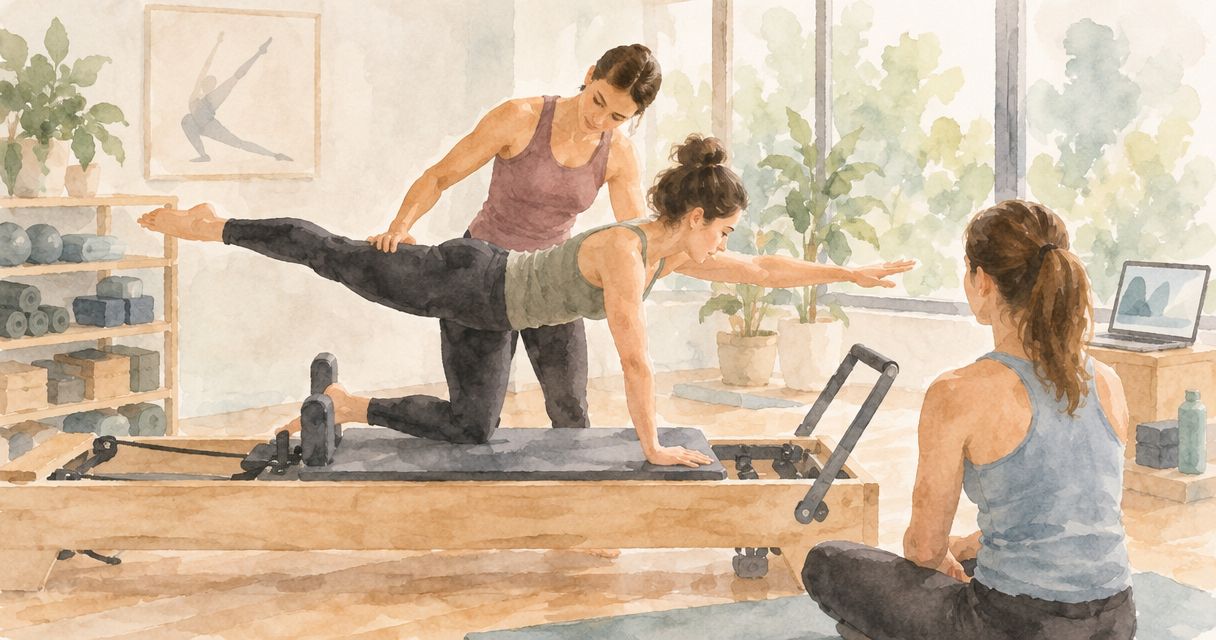
At $497 tuition, TeachPilates offers flexible, self-paced online study; when comparing Pilates certification programs, choose a teaching mentor whose teaching scope, feedback process, and assessment role match your goals. Confirm mentoring arrangements separately from curriculum coverage, because course access does not establish that individual coaching, hands-on Reformer qualification, or an independent credential is included.
- TeachPilates suits self-paced online learners; confirm mentoring arrangements separately when comparing Pilates certification programs.
- Choose a teaching mentor for relevant feedback, not just personal teaching style or an impressive exercise demonstration.
- Separate mat-teaching foundations, introductory Reformer concepts, and dedicated hands-on apparatus qualification.
- Before enrolling, confirm who reviews your teaching, how feedback works, and what assessments require.
Why this matters
Your experience taking Pilates classes gives you a starting point, not a complete plan for teaching someone else. A mentor should help you examine your instructions, exercise choices, and responses to a learner—not simply encourage you to practice more.
TeachPilates is best for Pilates practitioners seeking self-paced online instructor training. Its stated curriculum covers anatomy, mat and Reformer instruction, cueing, and business skills; review TeachPilates against the teaching role you want, then confirm the support arrangements before enrolling.
This guide is published by TeachPilates. Use the same checks for this course and any other Pilates certification programs you consider in 2026: establish the teaching scope first, then examine how someone will help you reach it.
How do you choose a mentor in Pilates certification programs?
Choose a mentor by matching their role to the teaching you want to do. Then establish what they will review, how you will receive feedback, and whether they participate in your assessment. A helpful conversation is not the same service as an observed teaching review.
Use this comparison to distinguish support arrangements. These are formats to ask about, not claims that a particular provider includes them.
| Support format | Best for | Main benefit | Limitation to check |
|---|---|---|---|
| Written questions | Clarifying anatomy or lesson instructions | Lets you frame a precise question | Written explanations alone do not show how you teach |
| Recorded teaching review | Reviewing cueing and lesson delivery | Gives the reviewer an example of your teaching | Camera placement can leave important details unseen |
| Live remote mentoring | Discussing decisions while demonstrating | Allows questions and follow-up during the session | The mentor sees only what your setup shows |
| In-person mentoring | Physical setup and equipment-based practice | Allows direct observation in the teaching space | Location and scheduling must fit your circumstances |
Do not choose a format in isolation. Ask what the mentor actually does within it: answer questions, observe teaching, suggest corrections, assess performance, or some combination of those tasks.
Start with the teaching role you want
Write a plain-language goal before comparing mentors: you want to teach mat classes, work toward apparatus instruction, or develop another clearly defined teaching role. That goal gives you a useful test for every support promise.
For your 2026 enrollment decision, distinguish mat-teaching foundations and introductory Reformer concepts from dedicated hands-on apparatus qualification. A course mentioning Reformer instruction does not, by itself, establish the depth of equipment practice or assessment.
Ask prospective mentors which teaching tasks they review. Someone who explains anatomy clearly still needs a relevant process for reviewing your class instructions if cueing is where you need help.
Check the mentor's role before their teaching style
You can enjoy a teacher's classes without knowing whether their mentoring fits your training needs. Ask about their preparation for the teaching scope you want, their experience reviewing trainee instruction, and their responsibilities within the course.
Request factual answers rather than relying on a profile description. Who delivers the support? Who substitutes if that person is unavailable? Does the mentor assess your work, or does another person make the assessment decision?
What should you confirm before committing?
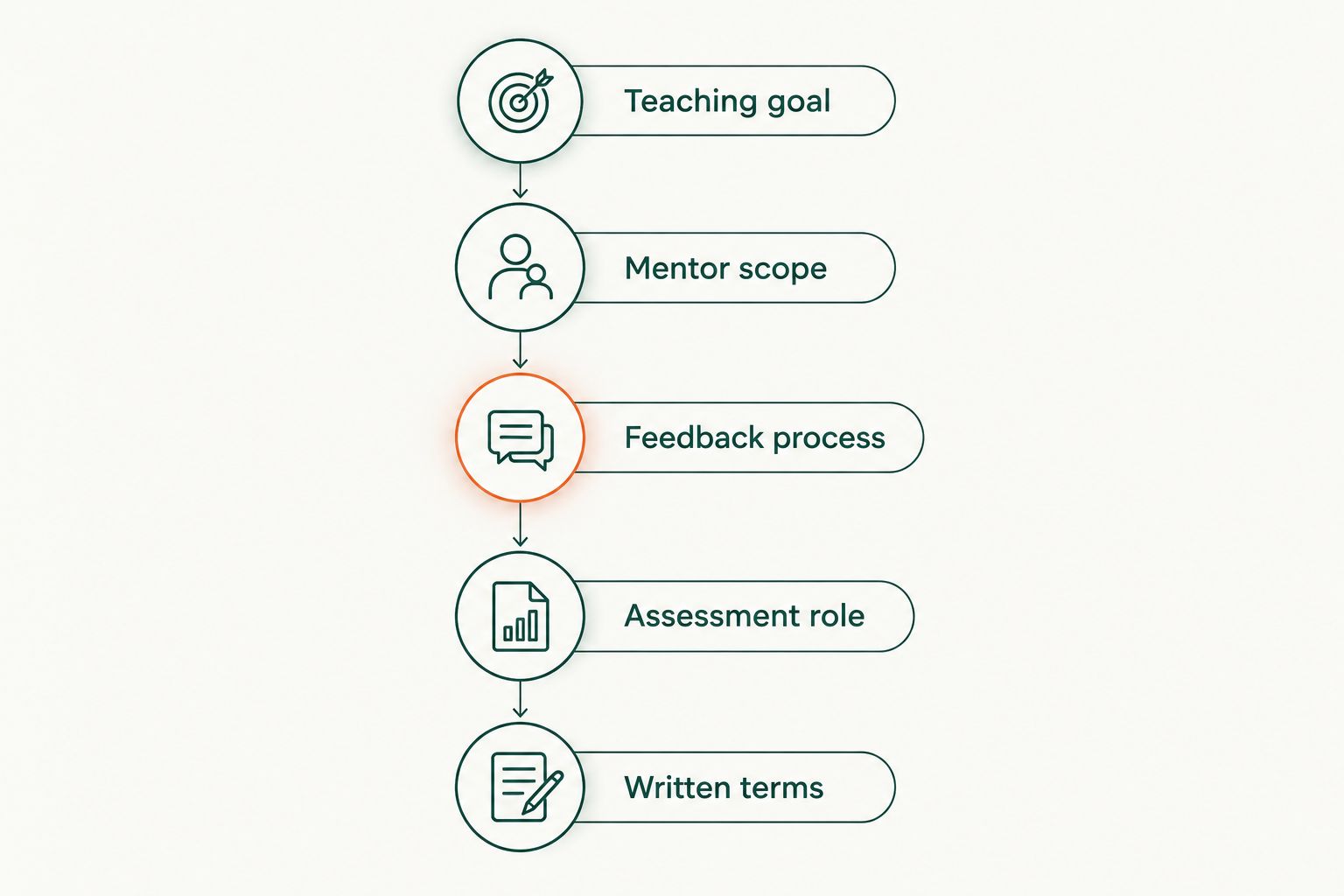
Use this sequence before paying tuition or arranging separate mentoring. Keep the answers together so you can compare the same services across providers rather than comparing a detailed offer with a vague promise.
- Teaching goal: State the classes or sessions you want to prepare to teach.
- Mentor scope: Confirm which parts of that goal the mentor can review.
- Feedback process: Ask what you submit and what the response contains.
- Assessment role: Establish whether mentoring and assessment are separate.
- Written terms: Confirm access, scheduling, boundaries, and any additional charges.
Each step should produce something concrete: a stated teaching scope, a submission method, assessment information, or written support terms. If an answer only repeats that support is available, ask a narrower question.
A clear process also helps you identify what you must arrange yourself. For example, you should know whether practice-teaching observation happens within course support or needs a separate arrangement; neither should be assumed from the word mentoring.
What should useful teaching feedback cover?
Useful feedback connects an observed teaching choice to a specific correction you can practice. Praise can encourage you, but it does not replace an explanation of what needs changing and how to check your next attempt.
Ask whether the review process addresses these areas:
- Instructions: Can a learner understand the starting position and intended movement?
- Cueing: Does your wording help the learner act without unnecessary explanation?
- Exercise choices: Can you explain why an exercise belongs in the lesson?
- Modifications: Can you describe an appropriate adjustment within your training scope?
- Reflection: Can you identify what worked and what you would change?
These are questions for evaluating a review process, not a claim about any provider's assessment rubric. Ask to see the criteria that actually apply to your course.
For a closer look at support arrangements, use the guide to evaluating tutor support. Focus on what happens after you submit a question or teaching sample, not just whether a support channel exists.
Ask how you will use the feedback
Before enrolling, ask how you can demonstrate that you have addressed a correction. Does the arrangement allow another submission, a follow-up discussion, or a later assessment? Get the actual terms rather than assuming that feedback includes repeated review.
A useful personal practice is to record the original issue, the correction you tried, and what you want reviewed next. That gives your next question a clear purpose without turning your mentor into someone who must plan every practice session for you.
Why mentoring arrangements vary
Mentoring arrangements differ because the teaching task, delivery method, and assessment responsibilities differ. Compare these factors when reviewing a 2026 course offer:
- Teaching scope: Mat instruction and apparatus instruction involve different teaching settings; establish what the mentoring covers.
- Review method: Written questions, recorded submissions, and live observation provide different views of your work.
- Individual attention: Confirm whether responses address your own teaching or questions from a group.
- Assessment responsibility: The person helping you practice is not automatically the person deciding whether you pass.
- Access terms: Check support windows, booking arrangements, submission limits, and course expiry terms.
- Practice setting: Establish whether you need equipment, a suitable space, or another person for teaching submissions.
Do not treat an unanswered question as an included service. Put unresolved items on your enrollment checklist and request clarification before committing.
How should you compare tuition and mentoring costs?
TeachPilates' stated tuition is $497 for self-paced online instructor training. That figure does not, by itself, establish the terms of individual mentoring, equipment access, practical assessment, or an independent credential.
For your 2026 budget, separate tuition from any additional services a provider identifies. Ask whether assessment, reassessment, mentoring sessions, required materials, and equipment access carry separate charges; these are checks, not claims that every course charges for them.
Compare the same scope on each side. An online curriculum and an arrangement that includes in-person observed teaching are different offers, so the tuition figure alone cannot settle the decision.
Choose on documented teaching preparation, not the largest-looking bundle. A clearly described course lets you identify both what you are buying and what you still need to arrange.
What should self-paced learners check about access?
Self-paced study lets you organize your study schedule, but it does not define every access rule. Before choosing a course in 2026, check how long you can use the materials, when support is available, and whether assessments have separate deadlines.
Ask how mentoring fits around your practice. A course can let you study independently while still requiring you to book a review or submit work through a particular process; confirm the actual arrangement rather than treating flexibility as unlimited access.
If you are balancing training with work, map study, practice, and feedback separately. Your plan should leave room to act on corrections, not just finish watching lessons.
Can your favorite instructor be your teaching mentor?
Your favorite instructor can be a candidate, but enjoyment of their classes is not enough to establish a suitable mentoring arrangement. Ask whether they offer trainee reviews, what teaching scope they cover, and how their support relates to your course requirements.
A personal mentor and a course tutor can serve different purposes. Keep their responsibilities distinct, especially when only the course's designated assessor can make decisions about course completion.
Does online mentoring prepare you for Reformer teaching?
Online mentoring can support discussion and review of visible teaching tasks, but it does not establish dedicated hands-on Reformer qualification. Check the course's apparatus scope, equipment-practice requirements, and practical assessment before deciding that it matches your goal.
If apparatus teaching is your priority, establish where you will practice and who will observe that work. Introductory concepts should not be presented as a substitute for a defined apparatus-training pathway.
Should your mentor also assess your work?
Your mentor does not have to be your assessor, but you need to know who holds each responsibility. Ask who explains corrections, who reviews revised work, and who decides whether you have met the course's assessment requirements.
If different people fill those roles, request the assessment criteria. Feedback is easier to act on when you understand which requirements your submitted work must demonstrate.
FAQ
What's the best way to compare Pilates certification programs for mentoring?
Compare the teaching scope, review method, individual attention, and assessment role in writing. Ask what you submit, who responds, and whether you can receive feedback on revised work.
Does TeachPilates include a personal teaching mentor?
Confirm personal mentoring arrangements directly with TeachPilates before enrolling. Its stated offer is self-paced online instructor training covering anatomy, mat and Reformer instruction, cueing, and business skills; that description does not establish individual mentoring terms.
How much is TeachPilates tuition?
TeachPilates' stated tuition is $497 for self-paced online instructor training. Confirm the current enrollment terms and whether any services you need sit outside tuition.
Can I choose a Pilates course without teaching experience?
You can consider first-time instructor training without prior teaching experience. Check the provider's entry requirements and how the course helps you move from personal practice to teaching others.
Is recorded feedback as useful as in-person mentoring?
Recorded feedback and in-person mentoring serve different review needs. A recording lets a mentor review visible teaching choices, while in-person observation allows the reviewer to see the physical teaching setting directly.
Will a Pilates certificate be accepted by every studio?
Do not assume a Pilates certificate will be accepted by every studio. Ask the studios where you want to work which training scope, practical preparation, and credentials they require.
Does course certification include an independent credential?
Do not assume course certification includes an independent credential. Confirm the credential's issuing organization, eligibility requirements, and any separate assessment before enrolling.
One last thing
Before enrolling, write down a teaching task you find difficult—such as explaining a starting position—and ask how the course's support would help you improve it. The answer should describe a process, not promise that confidence will appear after you finish the lessons.
Choose the arrangement that makes your next correction clear. That is a more useful test of mentoring fit than choosing the instructor whose classes you enjoy most.